
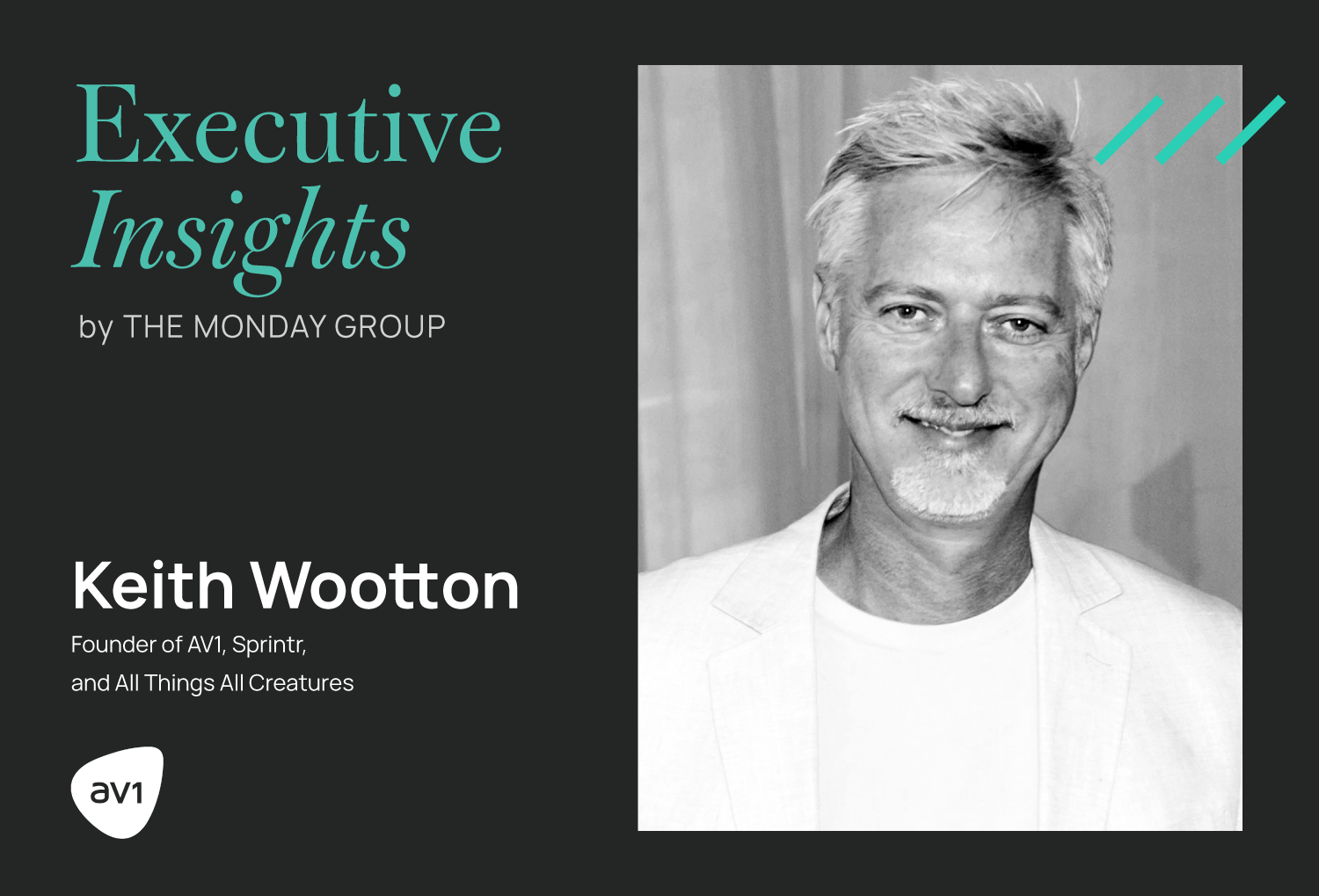
From Rock and Roll Dreams to Industry Leadership: Keith Wootton
Written by:
Jonathan Lamm
Posted on:
March 31, 2026
Welcome to the latest edition of THE MONDAY GROUP Executive Insights Series, shining a spotlight on the incredible Australian talent across the Hospitality, Hotel, Events and Experiential Marketing sectors.
For over three decades, Keith Wootton has been a driving force in Australia’s audio-visual and events industry. Starting AV1 with a desire to break the AV mould, he built the business from the ground up, growing it into one of the country’s most respected production companies.
Keith’s entrepreneurial spirit has since spawned Sprintr, a print-on-demand event tech brand, and All Things All Creatures, a video-first creative studio. Now, having stepped back from the day-to-day to let a new generation lead, Keith is focusing on what’s next, including exploring opportunities in Sydney’s live music and entertainment precincts.
In this edition of the Executive Insights Series, Jonathan Lamm, Managing Director of THE MONDAY GROUP, sits down with Keith, who shares lessons learned from a career defined by growth, the importance of culture, and why the events industry needs to tell its own story better.
What initially drew you into the events and AV industry?
I came from music. When I emigrated to Australia from Dublin, I couldn’t find a gig in the music business. For four months, I looked. Finally, my mum saw a little column ad in the Sydney Morning Herald for an audio-visual installer. She saw the word ‘audio’ and said I had to ring the number.
I rang, an Irishman answered, and I had an interview on the Friday and started on the Monday, the 14th of February 1994. I didn’t think I’d last a week. I even kept five of my six uniforms unworn because I thought I’d be handing them back.
I ended up staying for ten and a half years.
I moved from technician to account manager to operations to general manager. What kept me in the industry was the variety and the growth. I felt I was part of it and could contribute to it.
Then, in 2004, I started AV1. Once you start your own business, you’re all in, 24/7. When you’re not servicing customers, you’re thinking about the business, the branding, the structure, the people. It’s been a fantastic experiment over the last 22 years.
You’ve built multiple businesses over time. How did that evolve from AV1?
AV1 is the core, focused on corporate events. Sprintr came about because we were looking for an events app for our customers. We teamed up with a software company and ended up taking over their hardware and logistics, the check-in kiosks.
I came up with the name Sprintr: speedy printer. It was all about efficiency, getting into an event quickly instead of lining up at trestle tables full of pre-printed badges. It’s all about print-on-demand, so you only produce what you need. That business spun out on its own a couple of years back.
All Things All Creatures is a video content studio. It came out of a division called AV1 Media that we started back in 2011. It’s since evolved into a video-first creative studio, creating cinematic content for events, advertising, and marketing teams.
With the three businesses sitting side by side, complementing each other, I saw the opportunity to helicopter up and let others run them. We introduced employee share schemes and created space for new ownership and leadership, which allowed me to extract myself from the day-to-day and look for other opportunities in the industry.
Which earlier experiences most shaped how you lead now?
I think the industry itself shaped me. When I started, it was a bit of a Clayton’s job… the job you have when you don’t have a job. It was full of transient labour, people floating in and out. That made it difficult.
Now, it’s a lot more mature. There are so many skilled people who have stuck with it for 15 years plus, and that wealth of talent has really changed the industry. Everyone was kind of guessing back then, just trying their best with the tools they had. The customer was the expert; you were an order taker. Back then, clients would tell you what they wanted: “two lapel microphones and an overhead projector.”
These days, we are the experts. We take a brief and provide the specification of what’s needed.
What changes in client expectations have you noticed post‑pandemic?
There’s a shift in the conversation around attendees being spoken to rather than being involved. We see shorter keynotes and more discussion, more panels with lengthy Q&A and audience interaction. I think Zoom during the pandemic framed everyone on equal footing, and that’s carried over.
Now you’ll often hear, “I’m sorry we’re running out of time,” because there’s so much Q&A coming from the audience. We should capitalise on that and open up for broader discussion. The conferences that do that feel more effective. Attendees feel like they’ve contributed, they’ve been heard, and the data coming out is richer.
How do you balance technology with genuine experience?
There are different levels of immersion. You go to a Coldplay concert and you’re immersed wherever you sit. Without turning every staff meeting into a Coldplay concert, there are ways to get that feeling of engagement.
And it’s not always about the tech. If you’ve got a really poignant keynote speaker, you need nothing more than a lapel microphone and a spotlight. It’s horses for courses. I always say, we’re not into tech for tech’s sake, but whatever tech suits the actual purpose.
What challenges do you come up against today in building and maintaining culture and teams?
I’m very lucky to have long-standing staff. We’ve always spent a lot of time on culture, but not by forcing it. It just comes to be by having a set of guiding principles and commonalities.
A couple of practical things: we have regular gatherings, a lot of communication, and everyone contributes to the direction of the business. I’ve also issued shares to management and those who have been with AV1 for more than 10 years. It’s a way of rewarding and keeping people.
The real difficulty is the seasonality of our industry. I’d love to employ more full-time people, but you have to rely on freelance and casual work because of the ebb and flow. It’s still a real downfall that we have to rely on casual work so heavily.
How do you attract and retain skilled people?
We put ourselves out there from a marketing perspective, not only for customers but for staff. AV1 is a certified B Corp, which signals that we’re a business for good. Staff prefer to work for an organisation that is marked up for being good.
Whatever magic formula we’ve had over the last 20 years, it’s meant that we’ve got longstanding staff.
What’s your advice for someone starting out in the events industry today?
The mindset hasn’t changed. You need to be enthusiastic. You need to put your hand up and volunteer. It’s hard for younger people to walk through the door and fly their flag, but for those who can get into the industry, volunteer, be enthusiastic, and get to know the who’s who, there’s plenty of opportunity.
School leavers today come out with all kinds of skills around IT, video, and content production. Nearly everyone has helped somebody influence, so they know their way around a good camera shot. There’s a base level of skill there.
But determination and networking ability are still key. I’ve always put my hand up for things, even if I didn’t have all the knowledge. To a young person today: just get in, explore the industry, look up the different companies, call them, go and visit, show your worth and your enthusiasm.
How is new technology, especially AI, influencing your business?
AI just makes so much possible. You can ask it to design a set for an awards night or put together a run sheet. It may not be the perfect result, but in terms of building frameworks, it’s revolutionary.
For us, it allows visualisation. One of the biggest hurdles has always been trying to convey what a space will look like without spending hours on a 3D render. Now, you can take a spec sheet of equipment and have it visualised in a moment. You can ideate with a client live, shifting and adjusting designs on the fly.
It’s not just aesthetic design; it’s program design, making the event as effective as possible for the delegate. There are some great tools at our disposal if we’re willing to hop on board and use them.
What role does sustainability play in your businesses?
Thankfully, we are quite low waste because our equipment is not single‑use. We’ll get 100 rentals out of a projector, 500 out of a loudspeaker, maybe a thousand out of a microphone. Despite everything drawing electricity, we try to minimise that with LED and minimal power‑drawing equipment. We are measured on our impact as part of being a B Corp.
Even with Sprintr, we only print what’s required. You’re not wasting pre‑printed badges hoping 3,000 delegates show up. We’re using bamboo lanyards now that thread in rather than metal clasps. They’re all recycled and recyclable. The industry has come a long way. I remember when sets were made of polystyrene and went straight to landfill. Now everyone’s thinking about it.
What trends do you see shaping the events industry over the next five years?
I think there’s a real opportunity for more convergence across concerts, theatre, sports, and corporate events. We can capture the essence of all of them to provide new, engaging, and memorable experiences.
Events are now in competition more than ever. With Netflix, mobile devices, and all the entertainment at home, there’s a choice to be made. Will I go to an event, or will I watch something and get takeaway?
Events have to respond to that. They have to be as good as your last event. It’s not about transactional, get them in, stack the chairs, spin the tables. It’s about being memorable.
What’s next for you?
I’ve delved into some opportunities with the 24-hour economy commissioner in New South Wales. For me, that’s a passion project. There’s such support now for live music, performance, and engagement. They want to get people away from Netflix and out enjoying themselves.
If I can find an opportunity that has a little bit of musicality to it, that allows me to scratch that itch without taking on too much overhead, then I’d definitely be into that.
If you’re starting a company today, I’d probably say no to as many overheads as possible, and maybe collaborate earlier. Sharing the burden yields better results, for your business and your lifestyle
ABOUT AV1
AV1 blends audiovisual expertise with a genuine passion for creativity. They’re a full‑service production company offering a wide range of services, from lighting and complex stage setups to custom video content, motion graphics and hybrid event solutions. AV1 partners with clients at every step of the event journey.
With headquarters in Sydney and offices in Melbourne and the Gold Coast, AV1 operates with national and international reach. The team executes over 1,150 projects annually across more than 150 venues, supported by a highly trained full‑time crew and trusted freelance partners.
AV1 has been a certified B Corporation since 2016, reflecting its commitment to community, sustainability and leaving every situation better than it was found. With an NPS of 72 and 13 MEA award wins, the company is trusted by clients to deliver, professionally, with purpose and personality.
* * *
Need an expert insider to find leadership talent for your events or production business, or to take your next career step in the industry? Let’s talk.
Photography by Oneill Photographics

Aug 2026
Creating Places with Purpose: Rebecca Yazbek on Growth, People and Hospitality’s Next Chapter
Welcome to the latest edition of THE MONDAY GROUP Executive Insights Series, shining...
May 2026
Curiosity, creativity, and the changing face of hospitality: Danielle Alvarez
Welcome to the latest edition of THE MONDAY GROUP Executive Insights Series, shining a spotlight on the incredible Australian talent...
Dec 2025
Balancing product, profit and people in hospitality: Alex Kirkwood
Welcome to our third edition of THE MONDAY GROUP Executive Insights Series, shining a spotlight on the incredible Australian talent...